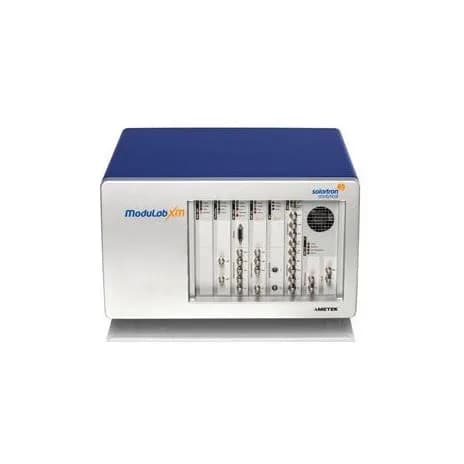
Analyseur d'impédance Modulab XM MTS
- Manufacturer
- Solartron analytical
- HTTS ref.
- HTS-ELEC-0011
- HTDS ref.
- STATION DE TESTS ELECTRIQUES DES MATERIAUX MODULAB
- Division
- Électrochimie & Tests
Gallery and technical drawings
Description
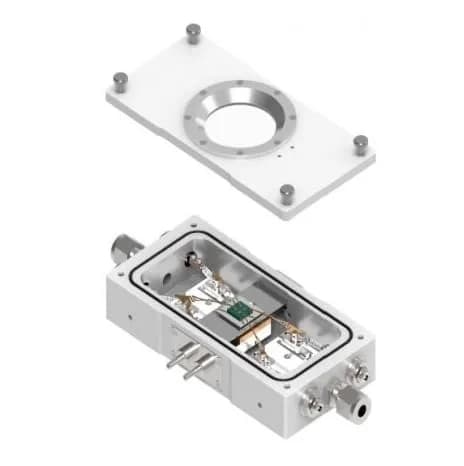
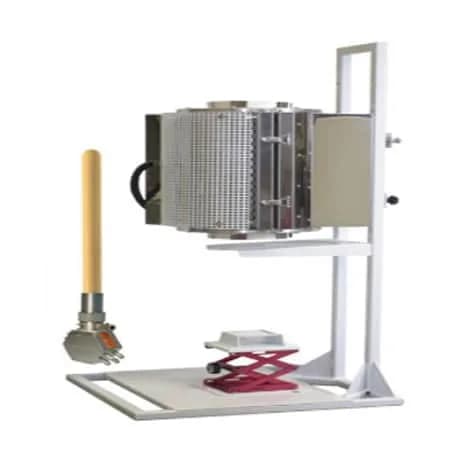
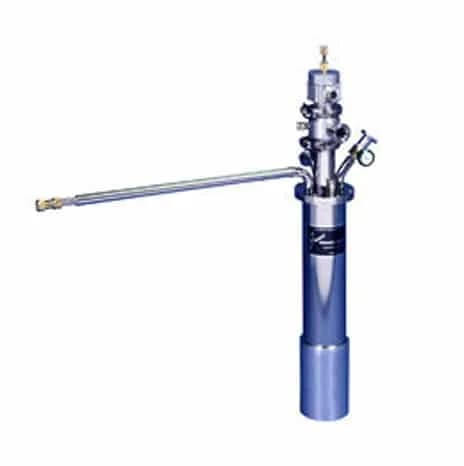
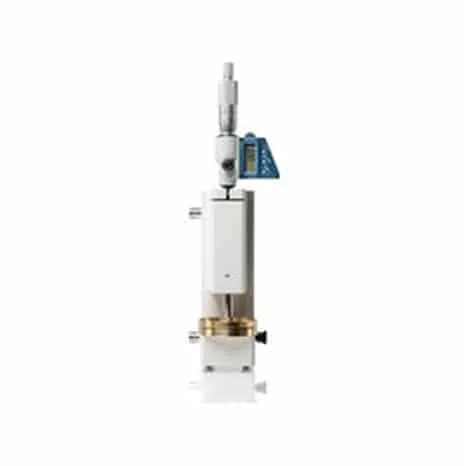
Le ModuLab XM MTS offre en standard une solution de caractérisation DC (résolution de l’ordre de la microseconde pour tests I-V, pulses, rampes…) et AC ( C-V, Mott-Schottky, impédance, permittivité, Tan Delta…). Permettant une polarisation de base de 8V et de 100mA en mesure, des modules optionnels internes au châssis permettront d’atteindre 100V en polarisation (module MHV100), et/ou 2A en mesure (module MBST 2A), mais aussi de doper la performance de mesure des petits courants (module MFA : FemtoA), ou encore de compenser automatiquement les imprécisions de mesure en rapport avec la connectique entre l’échantillon et l’analyseur ModuLab MTS XM (module MREF). Ces options rendront l’instrument idéal pour des caractérisations de matériaux TRES conducteurs (certains polymères et autres…) et/ou TRES PEU conducteurs (comme les matériaux diélectriques, les céramiques et les isolants). Liste non-exhaustive de matériaux testés par le ModuLab XM MTS :
La solution complète pour caractériser vos matériaux
Technical specifications
- Tel
- (865) 425-1289 Tel: +44 (0) 1252 556800
- Ranges
- 300 mA to 30 nA options) or 10 μHz to 300kHz
- Optique
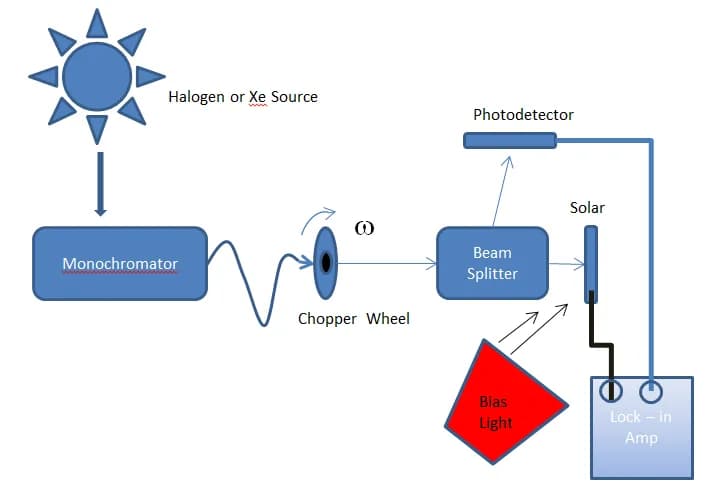
- Spectre couvert 350 nm – 1100 nm, 6 décades d’intensité lumineuse (avec filtre ND), divergence max du faisceau 4° (diamètre max 1 cm), calibration NIST, courant max du LED Driver 10 A, fréquence max du LED Driver (IMPS and IMVS) 250 kHz
- Slew Rate
- >10 V / μs
- Technique
- Parameters
- Cold White
- 1000 n/a
- Warm White
- 1000 n/a
- Connections
- 4 (each differential) Signal Output
- Slots Taken
- 1 Wavelength Range 350 nm - 1100 nm
- Potentiostat
- EIS 1 MHz (via FRA), échantillonnage jusqu’à 1 MS/s, tensions max ±8 V (±100 V en option), courants max ±300 mA (±2 A en option), précisions (lecture% + gamme%) 0.1% +0.05%, Impédance d’entrée >100 GΩ, <28 pF
- Cable Shields
- Driven / Ground
- Specification
- Same as RE above Waveform Single Sine, Multisine
- Analysis Modes
- Single Sine, FFT, Harmonic
- DC Measurement
- Synchronized to RE Single Sine Sweep Linear / Logarithmic
- IR compensation
- yes
- Input Impedance
- >100 GΩ, < 28 pF
- Maximum Current
- ± 300 mA
- Accuracy (ratio)
- ± 0.1%, ± 0.1°
- Cell Connections
- 2, 3 or 4 terminal Intensity Range 6 decades (with ND filter)
- LED Options (nm)
- Max Power (mA) Bandwidth (FWHM) (nm)
- Analysis Channels
- RE, WE, Aux A/B/C/D
- DC Bias Rejection
- Automatic
- Input Bias Current
- < 10 pA
- Maximum Resolution
- 1.5 pA Frequency Error ± 100 ppm
- Maximum Sample Rate
- 40 MS/s
- Maximum Time Record
- Unlimited Typical LED Stability at MAX power < 2% drift after 24hrs
- Floating Measurements
- yes Max Beam Diameter / cell size 1 cm
- Smooth Scan Generator
- 64 MS/s interpolated and filtered LED Driver Max Current 10 A
- Instrument Connections
- CE, WE, RE, lo Max Beam Divergence 4°
- Minimum Pulse Duration
- 1 μs
- Maximum ADC sample rate
- 1 MS/s Calibration NIST Traceable
- Bandwidth (decade steps)
- 1 MHz to 10 Hz
- Charge Extraction Methods
- Analyzer for improved signal to noise resolution. In addition, with built
- Current Polarization Range
- ± 300 mA (± 2 A)*
- Dye Sensitized Solar Cells
- Visible Spectrum - Photoelectrochemistry
- Voltage Polarization Range
- ± 8 V (± 100 V)*
- Excellent Thermal Stability
- Multi-Sine FFT)
- Extraction Techniques , I-V
- IMVS Effective Lifetime of Electrons
- DC Scan Rate (galvanostatic)
- 60 kA/s to 200 μA/s IMVS)
- Maximum Voltage Measurements
- ± 8 V
- DC Scan Rate (potentiostatic)
- 1.6 MV/s to 1 μV/s LED Driver Max Frequency (IMPS and 250 kHz
- Anti-alias and digital filters
- Automatic
- Maximum Compliance (Ce. vs LO)
- ± 8 V
- Collimation and Focusing Optics
- magnitude of light.
- Impedance Measurement Bandwidth
- 1 MHz (via FRA) Multi-Sine All Frequencies or Selected
- NIST Traceable Results Packages
- Existing systems can be upgraded to ModuLab XM PhotoEchem
- Auxilary Electrodes (A, B, C, D)
- urement (single sine, FFT or Harmonic)
- Approximate power of each setting
- 10 - 100 μW per cm
- addition of a reference mode. A 50
- 50 Anti-Reflective Coated
- Compliance Voltage Range (floating)
- ± 8 V Minimum Integration Time per meas- 10 ms
- NIST Traceable Calibration of Light Sources
- and the reference detector. The response of the cell under test
- *Not compatible with Photoelectrochemical card
- Analysis Channels
- Control and Measure up to 6 decades of Light Intensity
- thus eliminating errors associated phase shift and changes in
- Accuracy (reading % +range % + offset) 0.1% + 0.05% + 30 fA
- Frequency Resolution 1 in 65,000,000
- Excellent thermal management of light sources for long term
- Circuit
- including IMPS, IMVS, Impedance, PhotoVoltage Decay, Charge
- IMPS Effective Diffusion Coefficient of Electrons
- High Light Intensity Measurements Excellent Thermal Stability
- is directly compared with the response of the reference signal
- Other systems might experience poor temperature management of
- AC Voltammetry
- that many users are unfamiliar to many of these techniques and
- Auto - Analysis
- ModuLab XM PhotoEchem is a fully integrated photoelectrochemical
- Enhanced Productivity
- sensor inside each detector is supplied with an individual factory
- included:
- (specifically developed for Solartron ModuLab XM). The NIST traceable
- A comprehensive suite of standard electrochemical techniques is
- A comprehensive suite of techniques, developed by the leaders in this
- the end user. This greatly increases productivity and ease of use.
- calibration file. End users can refer all measurements in units of power
- Cyclic Voltammetry (Staircase and Linear Sweep)
- therefore, at the heart of the product concept is the ability to analyze
- Detailed Analysis of DSSC’s Has Never Been Easier
- ‘Auto’ analysis of data enabled for calculation of effective Diffusion
- Photo Voltage Delay Effective Lifetime of Electrons
Applications
- dispositifs photovoltaïques en général et organiques en particulier
- cellules solaires (dont Perovskites et Dssc)
- Quantum dot
- photo électrolyse de l’eau
- photo-batteries
- Toutes caractérisations électrochimiques en général
HTTSystems product sheet
Download the datasheet in our colours and contact details, or read it full screen.
Request a quote
Reference HTS-ELEC-0011 is carried into your file. You fill in the context, an engineer takes it from there.
Request a quoteTalk to an engineer
A question about installation, consumables or compatibility before pricing? Our engineers answer from Douala.
Ask the questionClose to this one
Same family, or same division when the family is thin.