Station photoélectrochimiques Modulab PhotoEchem
- Manufacturer
- Solartron analytical
- HTTS ref.
- HTS-ELEC-0013
- HTDS ref.
- MODULAB PHOTOECHEM POUR VOS MESURES PHOTOELECTROCH
- Division
- Électrochimie & Tests

Gallery and technical drawings


Description
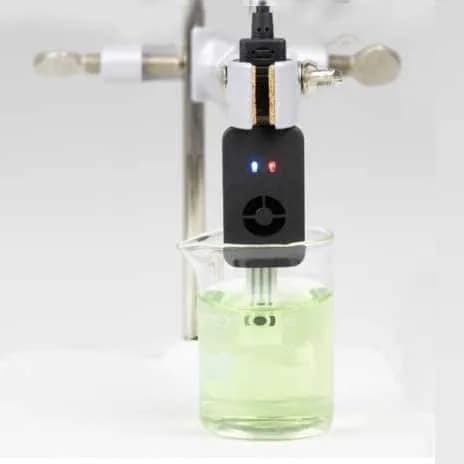
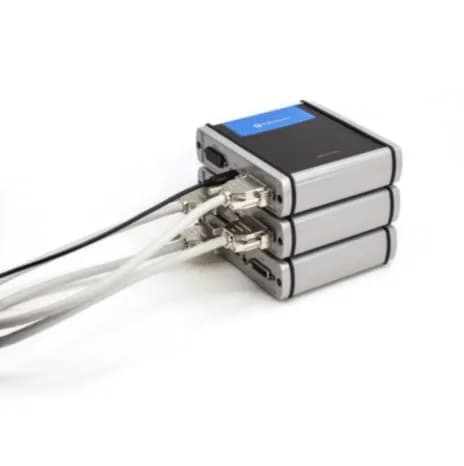
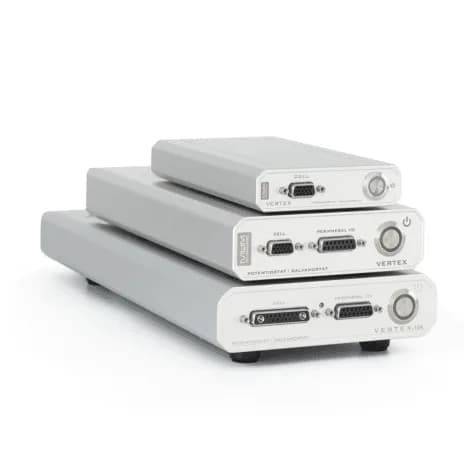
Basé sur le potentiostat/galvanostat ModuLab XM ECS, l’instrument offre en standard +/- 8V de polarisation et compliance et un courant maximal de +/- 300mA. L’ajout de modules optionnels internes au châssis permet d’atteindre des tensions de +/- 100V et des courants de +/- 2A tout comme de mesurer des très faibles courants jusqu’à une gamme minimale et directe de 3 picoA. Pour plus de courant, des boosters externes optionnels permettent d’atteindre 100A. L’appareil est livré avec un banc optique et une LED 590nm ; d’autres LED de haute intensité sont disponibles en option. L’option IPCE permet la mesure du rendement quantique : elle comprend une source de lumière blanche (350nm-1100nm) et d’un monochromateur offrant une résolution de 10nm. Le logiciel permet de calibrer optiquement (certifiée NIST) les mesures et, ensuite, de lancer toutes ou partie des expériences : IMPS, IMVS, Impedance, Photovoltage Decay, Charge Extraction, I-V. Le logiciel inclue également un volet d’Auto-Analyse menant au calcul automatique du temps de vie des électrons et coefficient de diffusion.
Station de caractérisations photoélectrochimiques ModuLab XM Photoelectrochemical Test System
Key features
- Banc optique incluant LED et/ou lumière blanche avec monochromateur (350nm-1100nm)
- Techniques clés-en-main : IMVS/IMPS, I-V, PhotoVoltage decay, Charge extraction, impédance et, en option, IPCE (rendement quantique)
- Modules optionnels « plug and play », afin de s’adapter à vos besoins
- Logiciel XM-studio PhotoEchem inclus, connexion Ethernet
Technical specifications
- Tel
- (865) 425-1289 Tel: +44 (0) 1252 556800
- Ranges
- 300 mA to 30 nA options) or 10 μHz to 300kHz
- Slew Rate
- >10 V / μs
- Technique
- Parameters
- Cold White
- 1000 n/a
- Warm White
- 1000 n/a
- Connections
- 4 (each differential) Signal Output
- Slots Taken
- 1 Wavelength Range 350 nm - 1100 nm
- Potentiostat
- Optics
- Cable Shields
- Driven / Ground
- Specification
- Same as RE above Waveform Single Sine, Multisine
- Analysis Modes
- Single Sine, FFT, Harmonic
- DC Measurement
- Synchronized to RE Single Sine Sweep Linear / Logarithmic
- IR compensation
- yes
- Input Impedance
- >100 GΩ, < 28 pF
- Maximum Current
- ± 300 mA
- Accuracy (ratio)
- ± 0.1%, ± 0.1°
- Cell Connections
- 2, 3 or 4 terminal Intensity Range 6 decades (with ND filter)
- LED Options (nm)
- Max Power (mA) Bandwidth (FWHM) (nm)
- Analysis Channels
- RE, WE, Aux A/B/C/D
- DC Bias Rejection
- Automatic
- Input Bias Current
- < 10 pA
- Maximum Resolution
- 1.5 pA Frequency Error ± 100 ppm
- Maximum Sample Rate
- 40 MS/s
- Maximum Time Record
- Unlimited Typical LED Stability at MAX power < 2% drift after 24hrs
- Floating Measurements
- yes Max Beam Diameter / cell size 1 cm
- Smooth Scan Generator
- 64 MS/s interpolated and filtered LED Driver Max Current 10 A
- Instrument Connections
- CE, WE, RE, lo Max Beam Divergence 4°
- Minimum Pulse Duration
- 1 μs
- Maximum ADC sample rate
- 1 MS/s Calibration NIST Traceable
- Bandwidth (decade steps)
- 1 MHz to 10 Hz
- Charge Extraction Methods
- Analyzer for improved signal to noise resolution. In addition, with built
- Current Polarization Range
- ± 300 mA (± 2 A)*
- Dye Sensitized Solar Cells
- Visible Spectrum - Photoelectrochemistry
- Voltage Polarization Range
- ± 8 V (± 100 V)*
- Excellent Thermal Stability
- Multi-Sine FFT)
- Extraction Techniques , I-V
- IMVS Effective Lifetime of Electrons
- DC Scan Rate (galvanostatic)
- 60 kA/s to 200 μA/s IMVS)
- Maximum Voltage Measurements
- ± 8 V
- DC Scan Rate (potentiostatic)
- 1.6 MV/s to 1 μV/s LED Driver Max Frequency (IMPS and 250 kHz
- Anti-alias and digital filters
- Automatic
- Maximum Compliance (Ce. vs LO)
- ± 8 V
- Collimation and Focusing Optics
- magnitude of light.
- Impedance Measurement Bandwidth
- 1 MHz (via FRA) Multi-Sine All Frequencies or Selected
- NIST Traceable Results Packages
- Existing systems can be upgraded to ModuLab XM PhotoEchem
- Auxilary Electrodes (A, B, C, D)
- urement (single sine, FFT or Harmonic)
- Approximate power of each setting
- 10 - 100 μW per cm
- addition of a reference mode. A 50
- 50 Anti-Reflective Coated
- Compliance Voltage Range (floating)
- ± 8 V Minimum Integration Time per meas- 10 ms
- NIST Traceable Calibration of Light Sources
- and the reference detector. The response of the cell under test
- *Not compatible with Photoelectrochemical card
- Analysis Channels
- Control and Measure up to 6 decades of Light Intensity
- thus eliminating errors associated phase shift and changes in
- Accuracy (reading % +range % + offset) 0.1% + 0.05% + 30 fA
- Frequency Resolution 1 in 65,000,000
- Excellent thermal management of light sources for long term
- Circuit
- including IMPS, IMVS, Impedance, PhotoVoltage Decay, Charge
- IMPS Effective Diffusion Coefficient of Electrons
- High Light Intensity Measurements Excellent Thermal Stability
- is directly compared with the response of the reference signal
- Other systems might experience poor temperature management of
- AC Voltammetry
- that many users are unfamiliar to many of these techniques and
- Auto - Analysis
- ModuLab XM PhotoEchem is a fully integrated photoelectrochemical
- Enhanced Productivity
- sensor inside each detector is supplied with an individual factory
- included:
- (specifically developed for Solartron ModuLab XM). The NIST traceable
- A comprehensive suite of standard electrochemical techniques is
- A comprehensive suite of techniques, developed by the leaders in this
- the end user. This greatly increases productivity and ease of use.
- calibration file. End users can refer all measurements in units of power
- Cyclic Voltammetry (Staircase and Linear Sweep)
- therefore, at the heart of the product concept is the ability to analyze
- Detailed Analysis of DSSC’s Has Never Been Easier
- ‘Auto’ analysis of data enabled for calculation of effective Diffusion
- Photo Voltage Delay Effective Lifetime of Electrons
Applications
- Caractérisation de cellules solaires
- Etude de l’electrolyse acqueuese directe pour la production d’hydrogène
- Photo-electrochimie
HTTSystems product sheet
Download the datasheet in our colours and contact details, or read it full screen.
Request a quote
Reference HTS-ELEC-0013 is carried into your file. You fill in the context, an engineer takes it from there.
Request a quoteTalk to an engineer
A question about installation, consumables or compatibility before pricing? Our engineers answer from Douala.
Ask the questionClose to this one
Same family, or same division when the family is thin.